

There is a quotation that arrives in a lot of inboxes in this industry: a rate per square foot, a total, and very little else. It is usually cheaper than the quotation from everybody else, and there is a reason for that.
A pre-engineered building is not a commodity. The same shed — same span, same height, same use — is a materially different structure in Coimbatore than it is in Nagapattinam, and different again in Kuwait. If the person quoting has not asked where the site is, they have not designed anything. They have priced a shed from a spreadsheet.
Here is what actually changes across India, and why it matters to what you pay and what you get.
Wind is the dominant load, and the Indian range is enormous
For most single-storey industrial buildings in India, wind — not the weight of the roof, not even the equipment inside — is the governing load case. A light steel roof is very good at being lifted.
IS 875 Part 3 divides the country into basic wind speed zones ranging from roughly 33 m/s in the sheltered interior to 55 m/s in the most exposed coastal belts. That is not a small spread. Wind pressure varies with the square of velocity, so a building on the Tamil Nadu coast at 50 m/s sees well over twice the pressure of one inland at 33 m/s.
Twice the pressure means heavier sections, more purlins, closer fastener spacing, stronger connections and larger foundations resisting uplift. A frame perfectly adequate in Hosur is simply not the same frame that belongs in Nagapattinam.
And there is a second layer most quotations ignore. The 2015 revision of IS 875 Part 3 introduced explicit provisions for cyclone-prone coastal regions — an additional factor applied within a defined distance of the coastline. Much of coastal Tamil Nadu, Andhra Pradesh and Odisha falls inside it. If you are building within that belt and your quotation does not mention it, ask why.
Seismic matters less than you would expect — until it does not
Counter-intuitively, seismic design is usually not the governing case for a light single-storey steel shed. Seismic force is proportional to mass, and a PEB has very little mass. This is one of the quiet advantages of building in steel in a country where much of the landmass sits in Zone III or above under IS 1893.
Where it starts to matter:
- Heavy mezzanines. A concrete floor slab inside your shed adds mass exactly where you least want it.
- Heavy equipment at height. Silos, tanks, hoppers, process vessels.
- Crane buildings. Crane loads and seismic combinations interact in ways that need proper analysis.
- Zone IV and V sites. The Himalayan belt, the Northeast, Kutch — the arithmetic changes.
The honest position: for a plain shed in Zone II or III, wind will govern. Once you add mass, that stops being safe to assume.
The coast eats buildings
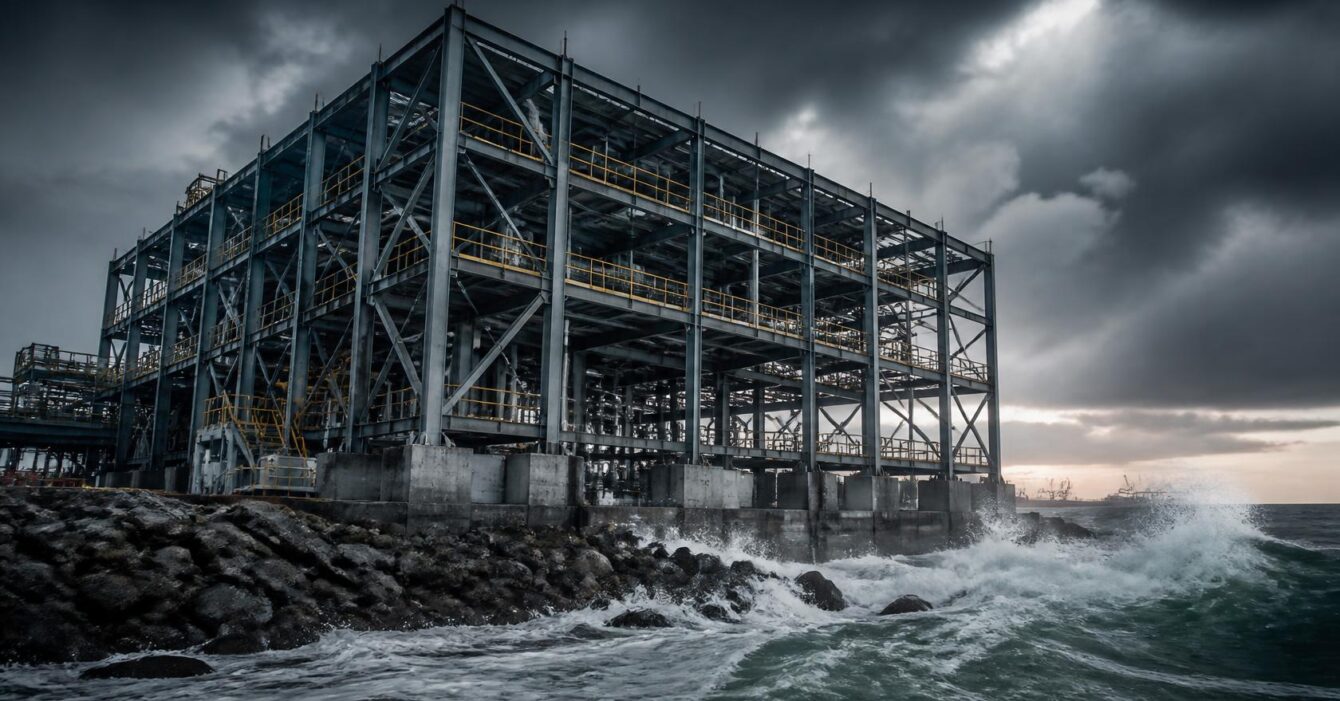
If your site is within a few kilometres of the sea — and a great many Tamil Nadu industrial sites are — corrosion is not a maintenance question. It is a specification question, and it is decided before you build.
Three things to get right.
Sheet coating. Standard galvalume is specified by coating mass. In a coastal atmosphere the standard grade will not give you the service life you are assuming. A heavier coating class, or a higher-performance paint system, costs a little more per square metre and adds years to the roof.
Fasteners and flashings. This is where coastal buildings fail first, and it is almost always false economy. The sheet is fine; the screws have gone. Stainless or properly coated fasteners with intact sealing washers are not the place to save money fifteen kilometres from the Bay of Bengal.
Dissimilar metals. Aluminium accessories fixed to a steel roof with the wrong fastener will corrode galvanically in salt air, quickly.
Monsoon detailing
Indian rainfall is not distributed like European rainfall. It arrives in short, extremely intense bursts, and a roof drainage system sized on annual averages will overflow in the first serious downpour.
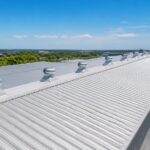
Gutters and downpipes should be sized on peak intensity for your district, not a national average. Roof slope matters more than people think — a flatter roof looks contemporary and holds water at every lap. And every penetration you make in a roof, ventilators included, is a place a monsoon will find.
What this means for your enquiry
A serious quotation should tell you what it assumed. At minimum:
- the basic wind speed used, and the terrain category
- whether cyclonic coastal provisions were applied
- the seismic zone, and whether seismic governed anything
- the coating specification on sheeting and fasteners
- the rainfall intensity used to size drainage
If a quotation states none of these, it has not been engineered for your site — and the difference between it and a proper design is not profit margin. It is the load cases somebody left out.
That is the part of this business that does not show up in a rate per square foot, and it is the part that decides whether your building is still doing its job in 2046.
Send us your location along with the dimensions, and we will tell you what governs on your site before we quote a number.